
Matrix Calculator
Enter one or two matrices and choose an operation. The calculator works with exact fractions, so inverses and solutions show 1/3 rather than 0.3333, and it lists the row operations used for Gauss–Jordan elimination so you can follow or check your own working. Matrices up to 8 × 8 are supported.
- Free to use
- No sign-up
- Runs in your browser
Matrix calculator
Row operation steps
Linear Algebra Practice Pack
Printable matrix operations cheat sheet, determinant and inverse practice worksheets with worked answers, a Gauss–Jordan elimination template and a matrix practice log.
- Cheat sheet (PDF)
- Determinants (PDF, DOCX)
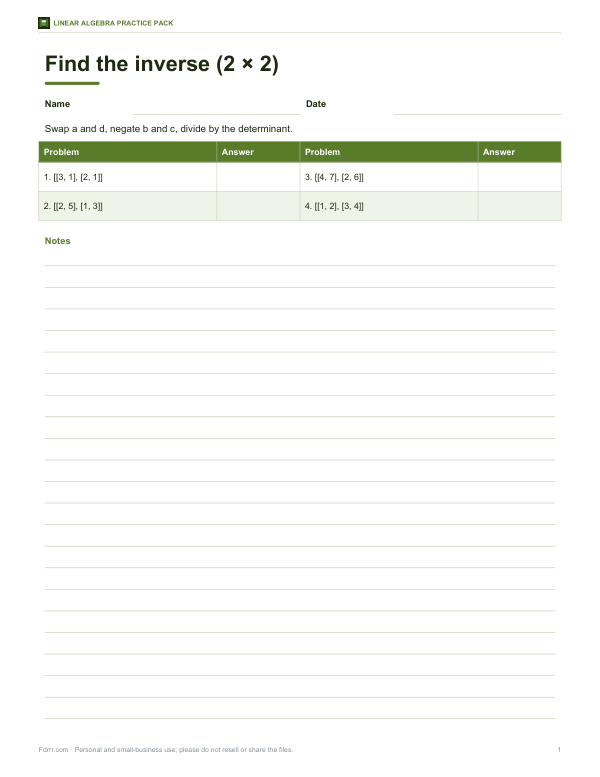
- Inverses (PDF, DOCX)
- Elimination template (PDF)
- Practice log (XLSX)
Formats: PDF, DOCX, XLSX. Instant download after payment (link valid 72 hours, up to 5 downloads). AI-assisted: the templates were drafted with AI help and reviewed and laid out before publishing.
$4.00 USD, one-time 5 files · about $0.80 each
- Instant download
- 7-day refund
- Secure checkout by Stripe
7-day money-back guarantee. Full refund within 7 days of purchase, even after you download.
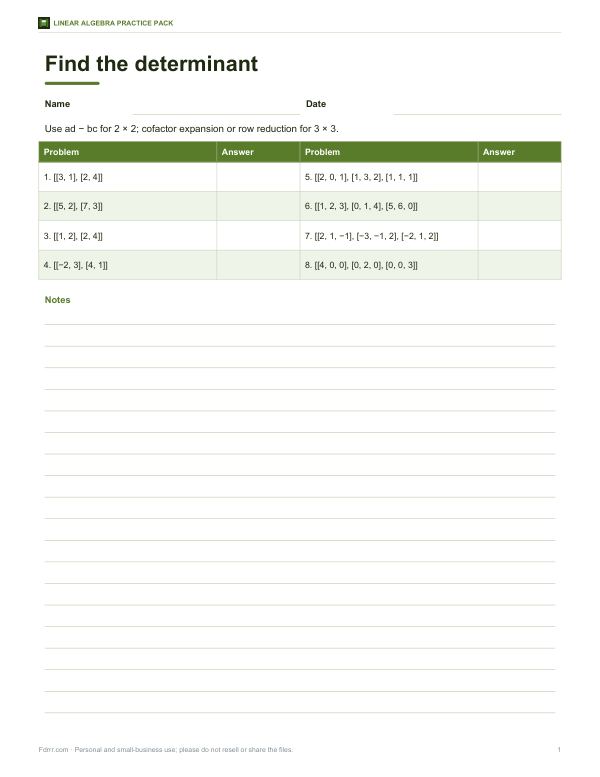
Free sample: Determinant Practice (PDF, 106 KB)
Full refund within 7 days — see the refund policy and license.
Free printables
Single sheets you can print right now, no sign-up. The full pack adds every sheet in one download plus the editable files.
 Printable Elimination Template
 Printable Linear Algebra Practice Log
What the calculator can do
| Operation | Requirement | Result |
|---|---|---|
| A + B, A − B | Same size | Entry-by-entry sum or difference |
| A × B | Columns of A = rows of B | Matrix product |
| Transpose | Any matrix | Rows become columns |
| Determinant | Square | A single number; zero means singular |
| Inverse | Square, non-zero determinant | A⁻¹ with A·A⁻¹ = I |
| RREF | Any matrix | Reduced row echelon form |
| Rank | Any matrix | Number of independent rows |
| Power | Square | A multiplied by itself n times |
| Solve Ax = b | b has one entry per row | Unique, none or infinitely many solutions |
Entering matrices
Type each row on its own line and separate entries with spaces or commas. You can use integers, decimals (0.25) or fractions (3/4); decimals are converted to exact fractions. For a system of equations, put the coefficients in A and the right-hand side in B as a single column. The default example is the system 2x + y − z = 8, −3x − y + 2z = −11, −2x + y + 2z = −3, whose solution is x = 2, y = 3, z = −1.
Gauss–Jordan elimination
Most operations here use Gauss–Jordan elimination: three row operations — swapping rows, multiplying a row by a non-zero number, and adding a multiple of one row to another — turn the matrix into reduced row echelon form, with leading 1s and zeros above and below them. Applied to [A | b], it solves linear systems; applied to [A | I], it produces the inverse; and the product of the pivots (with sign changes for swaps) gives the determinant. The steps list shows the operations used, such as “R2 − (−3/2)·R1”.
Determinants and invertibility
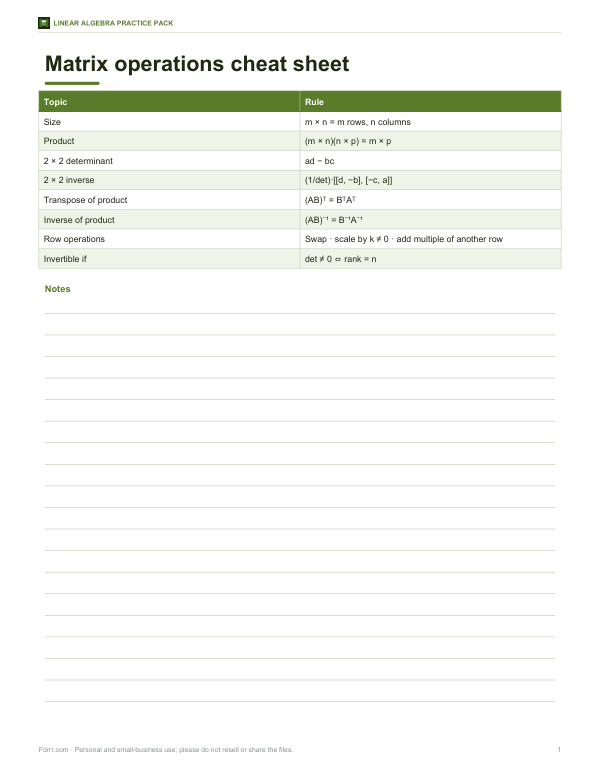
A square matrix is invertible exactly when its determinant is not zero. The determinant also tells you how the matrix scales area or volume: a 2 × 2 matrix with determinant 3 triples areas; a negative determinant flips orientation. For a 2 × 2 matrix [[a, b], [c, d]], det = ad − bc and the inverse is (1/det)·[[d, −b], [−c, a]].
Matrix multiplication rules
- The product AB exists only when A’s column count equals B’s row count; the result has A’s rows and B’s columns.
- Order matters: AB is usually not equal to BA.
- Each entry of AB is the dot product of a row of A with a column of B.
- The identity matrix I works like 1: AI = IA = A.
- (AB)ᵀ = BᵀAᵀ and (AB)⁻¹ = B⁻¹A⁻¹.
Worked example
For A = [[2, 1, −1], [−3, −1, 2], [−2, 1, 2]] and b = [8, −11, −3], “Solve Ax = b” reduces the augmented matrix to reduced row echelon form and reads off x₁ = 2, x₂ = 3, x₃ = −1. Switching to “Determinant” gives det(A) = −1, confirming the system has a unique solution, and “Inverse” shows A⁻¹ with integer entries because the determinant is ±1.
Where matrices are used
Matrices appear throughout science and engineering: solving circuits and structural systems, transforming coordinates in computer graphics, representing networks, running statistics and machine learning, and modelling population or economic changes over time with matrix powers.
Special matrices
| Matrix | Property |
|---|---|
| Identity (I) | 1s on the diagonal, 0 elsewhere; AI = IA = A |
| Zero matrix | All entries 0; A + 0 = A |
| Diagonal | Non-zero entries only on the diagonal; determinant is the product of the diagonal |
| Triangular | Zeros above or below the diagonal; determinant is the product of the diagonal |
| Symmetric | A = Aᵀ |
| Orthogonal | AᵀA = I; its inverse is its transpose |
| Singular | Determinant 0; no inverse |
Eigenvalues and beyond
Many courses move on from determinants and inverses to eigenvalues and eigenvectors, which describe directions a matrix only stretches. For a 2 × 2 matrix, eigenvalues solve λ² − (trace)·λ + det = 0. The determinant equals the product of the eigenvalues and the trace (sum of the diagonal) equals their sum — a handy check once you study them.
Checking your answers
- Multiply A by the inverse you found — you should get the identity matrix.
- Substitute a solution back into each equation.
- For a triangular matrix, the determinant is simply the product of the diagonal.
- Swapping two rows changes the sign of the determinant; multiplying a row by k multiplies it by k.
- Rank never exceeds the smaller of the number of rows and columns.
Limits and accuracy
The calculator uses exact rational arithmetic with standard JavaScript numbers, which is precise for typical classroom and textbook matrices. Very large entries or large matrices can overflow the safe integer range; in that case results may lose accuracy. For numerical work with large matrices, specialist software using floating-point methods is more appropriate.
Privacy
All calculations run in your browser; nothing is uploaded or stored.
Frequently asked questions
How do I find the inverse of a matrix?
Enter A and choose Inverse; the calculator row-reduces [A | I] to [I | A⁻¹].
When does a matrix have no inverse?
When its determinant is zero (it is singular).
Can I enter fractions?
Yes, type them like 3/4; results stay exact.
Why can’t I multiply my matrices?
The number of columns in A must equal the number of rows in B.
What is RREF?
Reduced row echelon form: leading 1s with zeros above and below them.
What does rank tell me?
The number of linearly independent rows or columns; a square matrix is invertible when its rank equals its size.
Why is AB not equal to BA?
Matrix multiplication combines rows of the first with columns of the second, so swapping the order usually changes the result.
Can it solve systems with more equations than unknowns?
Yes; it reports a unique solution, no solution or infinitely many.
Is my data stored?
No, it runs in your browser.